






Written by: Jeff Hale
September, 2026- For decades, metal fabricators running in-house powder coating operations have lived with a familiar trade-off. Manual application is flexible because an experienced operator can coat any part that comes down the line but it’s labor-intensive, inconsistent from one operator to the next and increasingly hard to staff.
Automated application solves the labor and consistency problem, but robotic or fixedposition gun systems need to be programmed before they can run properly or they will not produce the desired coated appearance.
That matters more than it did in the past. Fabricators today are coating a wider mix of part geometries, in smaller batch sizes, at higher line speeds than the automation on many shop oors was designed to operate. A job shop that previously ran a handful of part families for weeks at a time might now turn over its mix daily. Every new part style, every design revision, every one-off order means new programming time before the first good part comes off the line.
That tension is exactly what a newer generation of automated coating technology is built to address, and it’s worth understanding whether you’re running coating in-house or buying it as a service.
SENSING THE PART
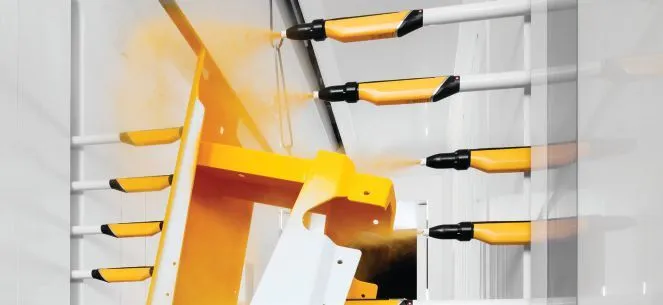
Rather than relying on a preprogrammed path for each part, these systems use laser scanners mounted at the booth entrance to detect the actual contour of each part as it entersits height, width and any protruding or recessed surfaces and then position the spray guns to the optimal target distance in real time. No two parts have to be identical, and no operator has to write a new program when the part mix changes. The system adjusts on the fly, part by part.
As a result, automation becomes viable for the kind of high-mix, variable-geometry work that many custom fabricators and contract coaters actually do, including on such products as office furniture components, HVAC housings, agricultural and construction equipment components, and structural fabrications with a mix of thick and thin sections. These parts have historically been hardest to automate because a fixed gun path either overcoats the easy surfaces or undercoats the hard-to-reach ones.
IN HOUSE COATERS
If your shop already runs automated coating, the relevant question isn’t whether your system works it’s whether it’s still matched to your current part mix. Fabricators who added automation years ago may be carrying more manual touch-up and rework than they realize, simply because new part geometries have crept in that the original programming never accounted for.
Sensor-based, adaptive gun positioning is worth evaluating specifically because it reduces or eliminates that reprogramming lag, and because more consistent gun-to-part distance directly improves first-pass transfer efficiency, meaning less overspray, less wasted powder and more predictable coating thickness across a varied part mix.
COATING AS A SERVICE
For fabricators that don’t coat in-house or who are weighing whether to bring the process inside versus continuing to outsource the work, this technology shift changes what a good vendor conversation should sound like. It’s no longer enough to ask a coating provider whether they’re automated.
The better questions are:
• How does your process handle a part geometry you haven’t run before?
• What’s your typical lead time to accommodate a new part style?
• What’s your first-pass transfer efficiency, and how consistent is coating thickness across a complex part versus a that panel?
A provider running adaptive, sensor-based automation should be able to answer those questions with real numbers and onboard a new part without a costly programming delay or increase in rejected parts.
THE BROADER SHIFT
None of this means every shop needs to automate or that manual application no longer has a place. For genuinely one-off or extremely low-volume work, it often still makes sense. But the underlying assumption that automation and flexibility are opposites is eroding. As part complexity and line speeds continue to climb, the ability to automate without programming for every variation is becoming less of a novelty and more of a baseline expectation. Fabricators evaluating either their own finishing operations or their vendors’ should be factoring that shi into the conversation now, rather than treating it as tomorrow’s problem.
Jeff Hale is marketing director for Gema ( http://gemapowdercoating.com/). He has held several positions at Gema, including engineering, product management, territory sales, distribution management and marketing. A U.S. patent recipient who serves as vice president of the Powder Coating Institute, Hale has given numerous presentations and written several articles on the powder coating process.