






Written by: Vijay Kancharla, product management director at IPG Photonics
October, 2026- Job shops and contract manufacturers have always lived with uncertainty. Unlike companies that produce the same parts in high volume for many years, their business model requires constantly adapting to changing customer requirements, variations in demand and new manufacturing challenges.
This operating environment makes capital investment decisions especially challenging. A welding system purchased for one contract may need to support very different work after that project ends. If it doesn’t, achieving a return on investment becomes much more difficult.
Contract manufacturers should evaluate more than a system’s ability to perform the job at hand. It’s useful to consider how equipment will adapt to future work as well. A system that can accommodate different materials, part geometries and production requirements is more likely to remain productive and to continue delivering a return on investment as business needs change.
CHOOSING SIDES
What does this mean in terms of the specific characteristics a manufacturer should look for in an automated production system? For welding, the first consideration is often the joining technology. In most cases, that means deciding between arc and laser welding.
But this choice isn’t simply a matter of deciding which process is “better.” Each technology has applications where it delivers the greatest value.
Arc welding remains the preferred choice for many structural and general fabrication applications because of its versatility and relatively low capital cost. Laser welding excels where speed, precision, low heat input and minimal distortion create measurable production advantages.
This is precisely what creates the challenge for contract manufacturers. Neither process is the right answer for every application. So, the technology that works best for today’s project may not be optimal for the next. But traditionally, the only available equipment option has been an either/or choiceat least for automated welders.
The good news is that equipment manufacturers are now addressing this issue with welding automation platforms that offer greater inherent flexibility. Rather than committing manufacturers to a single welding process, these flexible systems can be initially configured for either arc or laser welding and then subsequently changed to the other technology.
An example of this new breed of flexible, automated welding platforms is the IPG Photonics FlexCell. It can be initially configured for either arc or laser welding and then adjusted in the future. This better enables manufacturers to improve equipment utilization even in the face of changing needs, and reduces the risk associated with process-specific capital investments.
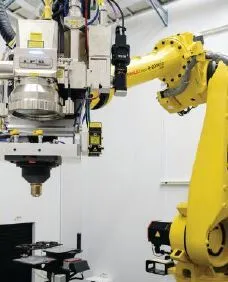
Fabricators can adjust to changing requirements with a flexible machine that can start with arc welding and add laser capability later.
BEYOND THE MACHINE
Hardware flexibility is only one part of the solution. A system that can switch between welding processes offers little advantage if doing so requires operators to learn an entirely new work ow or undergo extensive retraining.
Ideally, changing the welding method should have minimal impact on how the system is operated. A consistent interface, programming environment and part-loading process allow operators to build on existing skills rather than start from scratch each time the welding process changes.
This was the design approach used in the FlexCell. Although it can be configured for either arc or laser welding, both versions use the same robot programming methods and operator work ow. By maintaining a consistent user experience across both processes, the system reduces training requirements while preserving the flexibility to adapt as production needs evolve.
As welding becomes more complex and the jobs more demanding, however, manufacturers will confront challenges with even the best designed and easiest-to-use machine. New materials, unfamiliar joint designs or more stringent weld requirements may introduce process challenges that extend beyond operating the equipment itself. It is unrealistic to expect most shops to have all the in-house expertise needed to tackle every new application independently.
That makes the automation supplier just as important as the hardware. Beyond installing the equipment, the supplier should be able to provide process development, applications engineering, operator training and ongoing technical support as production requirements evolve. For manufacturers adopting laser welding in particular, access to experienced process engineers can significantly reduce implementation time and help qualify new work more quickly.
The relationship should also extend beyond the initial installation. Suppliers that can provide future software updates, hardware upgrades, and process enhancements help manufacturers keep equipment productive as customer requirements change. That ongoing partnership not only extends system life but also helps protect the original capital investment.
Vijay Kancharla is a product management director at IPG Photonics, Marlborough, Massachusetts ipgphotonics.com