






Above: Small and mid-sized companies, like fab shops, cite five misconceptions holding them back from leveraging AI for greater efficiencies.
September, 2026- While large manufacturers are embracing artificial intelligence (AI) with gusto, small and medium-sized businesses like fabricators are less enthusiastic as demonstrated by a slower rate of adoption. ECI Software Solutions reports that such reluctance is the result of several misconceptions that business owners have about AI: it’s too expensive, too technical or only for large corporations.
In actuality, ECI Solutions suggests that AI is becoming more accessible to companies of all sizes. “We found that several misconceptions about AI are holding [people] back from leveraging the full potential of artificial intelligence,” notes Adam Sklader, ECI president, manufacturing.
Founded in 1999, ECI Solutions offers AI-powered end-to-end ERP software solutions for industry-specific, small and mid-sized customers, which includes job shops as well as discrete and batch manufacturing. Customers may “have a common friction point relating to AI adoption: Most do not have a clear picture of what AI can and cannot do for their business. The result is management paralysis leaders doing nothing because the path forward seems murky,” Sklader explains. To pave a clearer path for them, Sklader debunks five misconceptions that are holding metals-intensive companies back from adding immediate value in such areas as inventory management, customer service and financial oversight.
MISCONCEPTION 1: AI IS ONLY FOR LARGE COMPANIES
Cloud-based platforms have completely changed the accessibility of AI, says Sklader. “This brings parity in terms of size. Companies no longer require massive IT teams or racks of servers to manage data and AI. Now, the heavy lifting and security can be performed by your ERP partner,” assures Sklader.
ERP systems from ECI Solutions integrate AI into everyday workflow. By democratizing AI, even a small business of just 10 employees can leverage business intelligence in the same way a 1,000-employee business might do, states Sklader.
He offers an example of a manufacturer he recently visited where he observed a lot of labor redundancies. “We were able to identify ways that AI and our ERP system could free up employee time so roles could be repurposed in ways that add more value and help set the company apart from its competitors,” reports Sklader.
ECI Solutions customers describe AI as a practical time-saver a benefit especially powerful in lean environments with limited resources. One survey of ECI’s customers found that 55 to 61 percent of respondents report efficiency gains by leveraging AI within their operations.
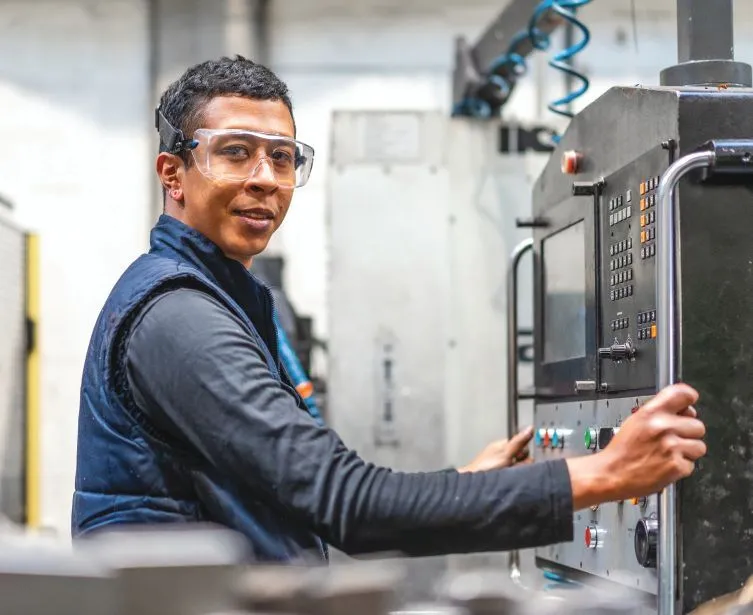
AI tools can help a fab shop remove the busy work—not the humans—from their operations.
MISCONCEPTION 2: AI REQUIRES TECHNICAL EXPERTISE
Unlike AI from just a few years ago, today’s intelligence is embedded directly into the service workflow. Sklader points to ECI’s new AI BOM Builder in JobBOSS . “This new tool transforms the traditional manual process of creating bills of material with AI running quietly under the hood,” he says.
With AI BOM Builder, shops can speed up workflows, reduce costly errors and seamlessly integrate into existing systems. All of this can be done without any intervention from an IT employee. Instead of manual entry, employees can focus on addressing anomalies and strategic decision-making, yet no coding or technical skills are required.
MISCONCEPTION 3: AI IS TOO EXPENSIVE
Cost is one of the more frequent objections Sklader hears from small and mid-sized companies. His response is always, “Compared to what?” As Sklader sees it, the real cost to a business is the labor expense to retype data manually or perform other redundant tasks. “In reality, AI is often less expensive than the manual labor it replaces,” he explains.
Sklader notes that AI is excellent at performing repetitive tasks, like entering vendor invoices or composing the first draft of a job description. When AI is embedded into an ERP system, the human role shifts from author to editor, from creator to manager, from doer to director.
AI can be particularly valuable for companies that are struggling to hire and retain skilled employees. “[They] can really benefit when low skill tasks are automated. Let’s face it: these are the tasks that most employees don’t enjoy doing.
“When talent is freed up from the low-skill tasks, they can focus on customer service and solving problems,” he continues. “These are the activities that underscore the value the employee contributes to the overall strategy. It helps connect an employee more closely to the company and the organization’s goals.”
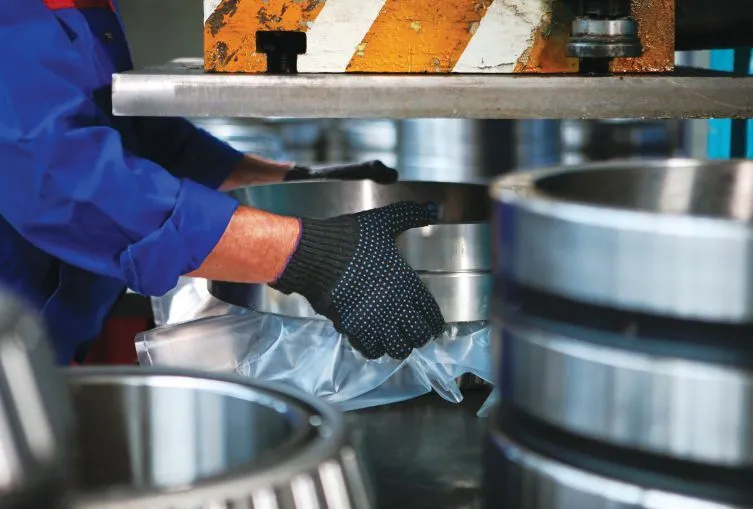
ECI’s new AI BOM Builder in JobBOSS² is helping fabricators get their hands around a bills of material tool that can speed up workflows.
MISCONCEPTION 4: AI REPLACES EMPLOYEES
News outlets continually report on people’s negative reactions to AI, driven by the fear that it will replace them in their jobs. “We have this conversation with customers all the time. It’s an emotional topic and one that we take very seriously at ECI Solutions,” says Sklader. “In reality, this is not true. AI removes the busy work, not the human.”
The ECI Solutions position on the topic is that AI is designed to augment human work, not eliminate it. Sklader points to a typical small or mid-sized manufacturing plant in which bottlenecks occur where there is a lack of skilled employees. “AI can become a workplace multiplier, shifting employees to higher value jobs,” he notes.
MISCONCEPTION 5: AI IS NOT SECURE
“Customer security concerns are understandable,” acknowledges Sklader. He cites an ECI Solutions adoption/engagement survey that reported 60 percent of respondents identifying data security and accuracy as a top concern when it comes to using AI.
“What we read about in the news are more likely data leaks relating to public AI tools,” clarifies Sklader. “What’s critical is not AI itself, but the ERP partner a [company] uses.”
With ECI Solutions, AI operates inside secure, controlled environments designed for business-critical data. “We have security built into our platform and supported by our own experts, who manage our systems everyday. We don’t leave it up to our customers to figure out their data security. We do that heavy lifting for them,” notes Sklader. By heavy lifting, Sklader means that his team understands the compliance aspect of security, data bandwidths and storage controls—where and by whom.
“The ECI Solutions philosophy is to keep AI inside the walls, not in the public sphere. Our AI systems operate within the same secure area as our ERP software. So it’s a controlled tool, encrypted, protected and time stamped—and with strict access control,” explains Sklader.
LAUNCHING AI
Now that the misconceptions have been cleared up, how does a fabricator or small or medium-sized business introduce AI into their operations? Sklader suggests starting with a company’s pain point.
“Let us know where the business is struggling and we can advise on ways to lean into AI for a solution.” He anticipates that many customers already have AI-compatible tools in their ERP system, like AI BOM Builder. “When using AI through your ERP system, it’s a costeffective and secure way to put your small or medium-sized business on equal footing with your largest competitors. All you have to do is take the first step!”
ECI Software Solutions, 800/959-3367, ecisolutions.com.