






Sandvik and the world’s first smash-proof guitar
Sandvik and the world’s first smash-proof guitar
April 2019 - What will happen if you introduce a supposedly smash-proof, all metal and 3D printed guitar, to a notoriously smash happy guitarist? Sandvik has worked hard to give you the answer!
The Journey
Through rock and roll history, thousands of guitars have been smashed and broken into pieces. Many rock legends and icons have contributed to this tradition, but few have been smashing their instruments as passionately as guitarist Yngwie Malmsteen. As he claims himself, the number has probably reached more than a hundred. Time Magazine has honored the virtuoso by naming him among the ten greatest electric guitarists of all time. His neoclassical playing style inspired by Paganini and Bach, doesn’t suggest a destructive nature. However, Malmsteen’s on-stage persona took form when he was introduced to Jimi Hendrix as a youth.

“When I was 7, I saw Jimi Hendrix smashing a guitar on tv – so, I started playing the guitar, so I could smash it,” Malmsteen revealed.
For precisely this reason, Sandvik chose to offer him their unique guitar in all metal, with a 3D printed titanium body, which was carefully and meticulously engineered but built for durability.
Being a world leader in material innovation, manufacturing and engineering, Sandvik was determined to showcase their ability to include sustainable methods and pioneering techniques to deliver something exceedingly accurate and surprisingly resilient.
The Process
The team’s goal was to develop an unsmashable guitar, but also to create a beautiful instrument which hasn’t been seen before. The electric guitar is a quite complex instrument, and therefore had to be constructed through five core components; the fretboard, the isotropic lightweight structure, the neck, the body and the knobs. With each component revealing a separate challenge.
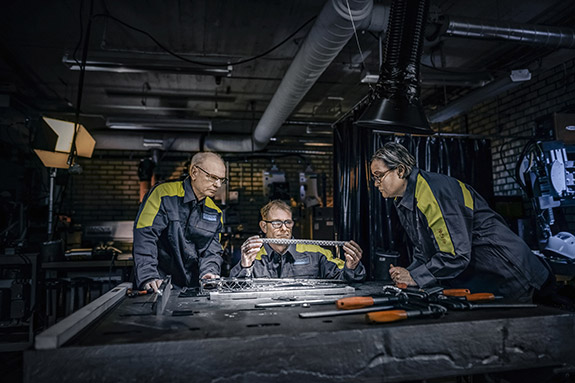
As Andy Holt at Drewman Guitars, who helped Sandvik to design the guitar, expressed: “Every element had to be drawn from scratch.”
The primary challenge was to address the immediate weakness of the frail joint between neck and body, that easily breaks. To accommodate the issue, they chose to eliminate the joint and re-engineered the connection. Instead, the fretboard and the guitar’s neck are both extended into a rectangular “hub” that would reach deep into the guitar’s body. They were milled in one machine from hyper-duplex bars of recycled stainless steel - a guitar construction that had never been tried before.
To build the first unbreakable guitar, barriers must be broken. Sandvik’s research and development department proposed an Isotropic Lightweight Structure (ILS) – the strongest structure for any given weight ever invented. Through a difficult and carefully analyzed welding process, the ILS structure was sandwiched between the fretboard and the neck. Thereby, concealing additional sturdiness without compromising the guitar’s visual expression.
The 3D titanium body
Solving the joint problem, was only the beginning. Sandvik gathered experts in materials, machining processes and additive manufacturing (also called 3D printing), from across the company to address each specific component of the guitar.
The next challenge was manufacturing a tremendously complex design - the guitar body. The internal structures of the body made it impossible to mill. Therefore, the choice fell upon additive manufacturing.
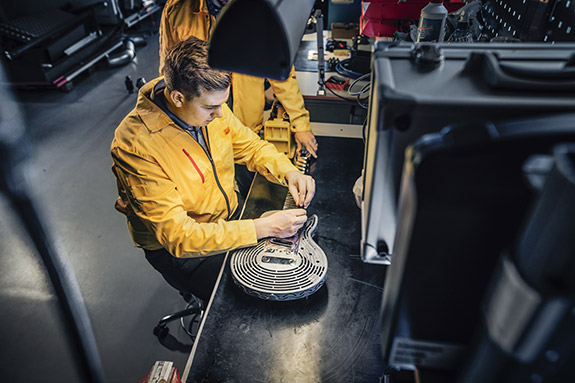
Amelie Norrby, an additive manufacturing engineer who participated in the guitar project, detailed the decision: “The benefit is that you can create completely new kinds of design, which aren’t possible with conventional metal cutting today.”
To print the body, titanium powder was added layer by layer, thereby building up the three-dimensional object directly from the digital design. The metal was melted together through laser technology and allowed the body’s intricate geometry to see the day of light.
Additionally, the guitar’s volume knobs were created through the 3D printing in stainless steel.
The Sustainability
Additive manufacturing is a ground-breaking and disruptive technology in many facets, one of which is its apparent sustainability feature. This could ideally improve both the manufacturing efficiency and the cost in the future.
The material used for each component is accurately measured, which Amelie Norrby elaborates on: “The remaining powder, after the printing, will be reused for another print.” Waste is consequently reduced to almost zero percent.

Furthermore, the supply chain is diminished, by jumping straight from design to a three-dimensional product. This also means the production can stay localized, which leads to minimized storage, packaging and transportation costs and pollution.
The Precision
Sandvik wanted to create a strong guitar, but they also wanted to make it as light as possible. Thus, the interior surfaces had to be hollowed out. Notwithstanding, a rounded and scalloped fretboard is an essential detail, allowing Malmsteen to control notes precisely. To complete the task, engineers had to remove material in long, smooth arcs between frets. Milling down to a challenging thickness of one-millimeter in certain places.

Lengthy, slender components like the fretboard and neck are particularly vulnerable to distortion, during the machining process. As Henrik Loikkanen, a machining process developer at Sandvik explained: “This fretboard is really demanding when it comes to machining,” Loikkanen said. “Precision was critical. The height of each fret had to align perfectly, otherwise, we would hear the strings touching some of the frets.”
Through the automated milling process, only one machine was required to create the fretboard. It took 90 separate operations and was completed without stopping the machine once, to encode new directions or changing tools. With this process, one can reduce cycle time, extend tool life, and produce materials at a lower cost. This is data on the cutting edge
The Test
Despite the countless hours of engineering and painstaking attention to detail, the guitar wasn’t celebrated until Yngwie Malmsteen had put his “personal touch” on this complicated and revolutionary instrument. Sandvik knows that collaboration is the key to the future. The customers' challenges inspire Sandvik to be more creative and forward-thinking. Sandvik is, therefore, bringing their personal expertise, to work together with their partners and customers, to reach new and innovative frontiers.
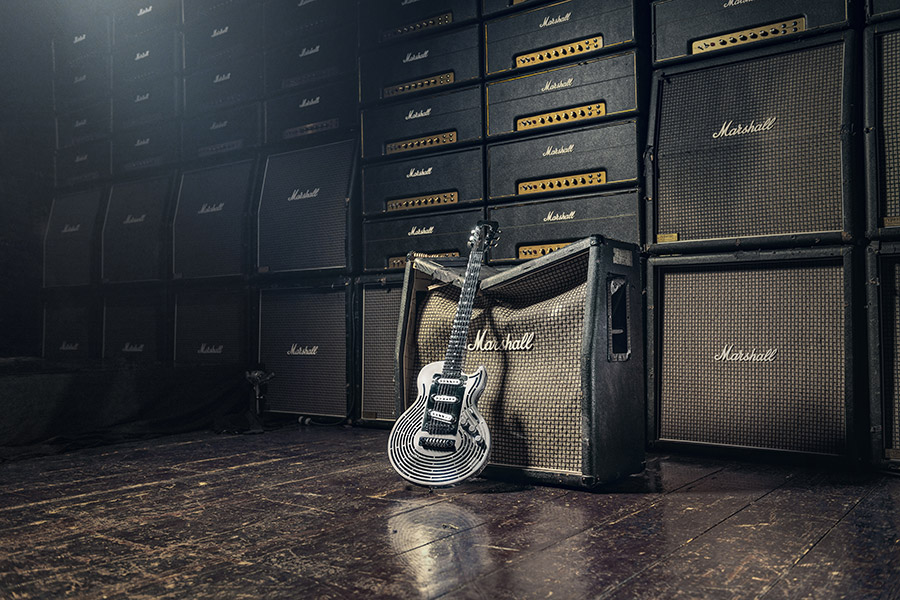
With a masterful performance, Malmsteen played the 3D printed metal guitar with flawless precision and uncanny speed. After the session, Malmsteen hurled the guitar into the air, making even the engineers gasp for a moment. But not the aerial manoeuvre, nor the crashing collision with the amplifiers, made a single dent in the guitar. The result is clear, the guitar is beautiful, perfectly playable and evidently smash-proof.
As Malmsteen most accurately proclaimed himself: “They put the work in, they do their hours, I can relate to that! The result is amazing! I gave everything I had, but it was impossible to smash – but you can break other things with it!”