






Above: Notching needs are met with a rectangular notching tool, standard on each machine.
October, 2026- After the purchase of a high-definition plasma or laser, an ironworker can end up in a corner of the shop. Mark Pearlman, who works in national ironworker sales for Amada Machinery America Inc., often asks these customers why the ironworker has been relegated to the side.
“Don’t you ever have to punch or shear just a few parts quickly without having to do an entire program and setup?” he asks them, noting that the customer’s response often is in the affirmative, but with a caveat that the ironworker doesn’t provide a good enough cut.
However, an ironworker that can make a good cut or punch with no deformation can be a valuable tool in a busy shop. Pearlman says customers often process parts like a small, square flat bar plate with a couple holes in it. “If you don’t need 500 of them cut out of a plate with a laser, the ironworker can be an efficient option.”
A customer in Los Angeles is “looking at four ironworkers, and they want to shear and punch channels. They have a huge job making frames, so they have lasers and plasmas but that’s not going to do the trick.”
Pearlman says that he often sells three to five machines at a time to customers for smallscale production applications. “If you just need 30 parts, you don’t want to have to take a million-dollar laser and put those 30 parts on it, taking it away from some other job. So you can do it on the ironworker.”
Major automotive manufacturers like Rivian and Subaru also use ironworkers in their maintenance shops because they “don’t have the space for a plasma, laser or tube laser, but they need to be efficient and to be able to make repairs. A maintenance supervisor who runs several of our ironworkers recently was telling me they don’t have time to do anything other than keep these car lines going, and ‘that’s why we have your ironworkers.’”
QUICK AND QUIET
Amada Machinery America machines have a quick-change coupling nut, dual die holder, LED lighting and a standard 3-foot electric backgauge. Pearlman says the round and square bar shear can handle channels, and the flat bar shear creates “absolutely no deformation.”
All ironworkers are built differently, he notes. Some of them end up bending the piece, while others require shims or are loud when punching the material. “Our machines are virtually silent. You hear the hydraulics engage, and then you hear the slug hit the slug bucket. To have something that goes through [material] so smoothly without vibrating or shaking is easier on the operator, especially if they have to punch 1,000 or 1,500 holes in a day.”
In addition, two operators can be working at the machine at the same time-one on the punch and the other on the shear. “It operates as two separate machines,” allowing projects to be worked simultaneously. “An operator can come over and start punching holes in the plates that the other person is shearing,” notes Pearlman. “Or if they’ve got a completely different project that needs a few holes punched, they can come over and do that, while allowing the operator who is shearing to continue.”
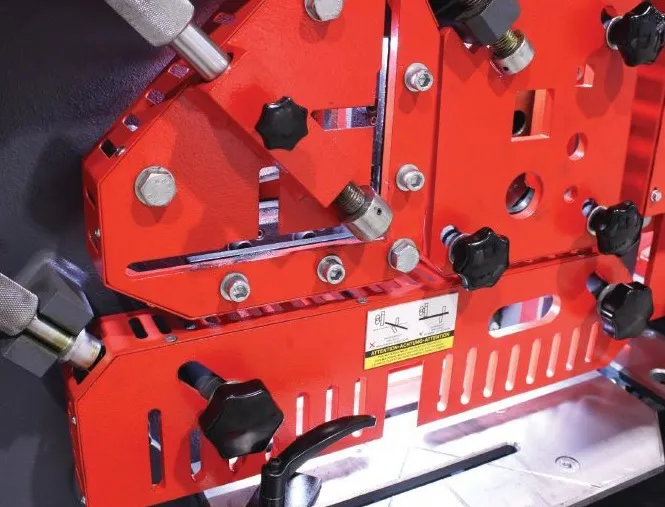
The angle shear allows for both straight and miter cuts of varying sizes of angle material without a drop-out slug.
Amada Machinery America ironworkers feature LED lighting at all workstations.
PUNCH, SHEAR, NOTCH
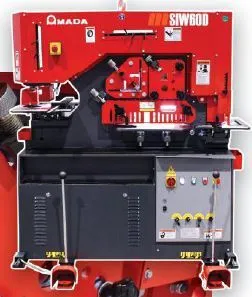
Amada Machinery America offers ironworkers from 60-ton up to 192-ton. Pearlman says the MSIW60D is Amada’s most popular machine, and it will handle-inch plate and down “excellently.” The 60-ton machines are the “sweet spot for every major brand of ironworkers, he says. “Somewhere between 60- and 65-ton is where probably 70 percent of ironworkers are sold.”
Customers looking to add an ironworker should start by evaluating the size of the material they’re working with, the size of the holes they want to punch and their material handling capabilities.
“All ironworkers are rated off the punch end of the machine using a 65,000 tensile strength material. The back end of the machines are all diverse, with the ability to handle different capacities depending on the width of the flat bar shears, the angle shears and the way material is presented into the machine,” Pearlman explains.
The company’s second most popular machine is the MSIW126D/DX, and its largest machine, the MSIW192DX, is often found in facilities like larger fabricators, shipyards and bridge manufacturers.
“The entire reason why you want to use an ironworker is speed. You walk over, cut your angle iron, and a minute later, you’re back. On a component-style machine, you might not have the right tool in place and by the time you change it out, you might as well just use a saw.
“It takes a lot of time to program automation,” he continues. “By the time you get done programming the laser, an ironworker has already sheared the part, punched the holes, and it’s on to the next process. You’re not standing around waiting for the guy to program the machine.”
Amada Machinery America Inc., amadamca.com.


