






Written by: David Bray, press brake product manager, MC Machinery Systems Inc.
Above: Press brakes fitted with automatic tool changers can help avoid and actively prevent costly downtime and product defects.
October, 2026- For decades, metal fabricators evaluating new equipment could generally choose among three levels of investment: high-performance premium machinery, mid-range equipment offering a balance of capability and price, and entry-level machines focused primarily on affordability.
That market is changing. The middle ground appears to be getting narrower as fabricators increasingly move toward two different purchasing strategies. At one end are companies for which initial equipment cost remains the primary consideration. At the other are manufacturers investing in advanced machinery to increase uptime, reliability, production and accuracy in the same or smaller footprint, with fewer operator-dependent processes.
One of the biggest forces behind that shift isn’t the machine itself. It’s the difficulty in finding operators needed to run today’s equipment.
PERSISTENT WORKFORCE CHALLENGES
Manufacturing’s labor challenge is well documented. Without significant changes to address skills and applicant gaps, as many as 1.9 million positions could remain unfilled. The issue isn’t simply finding people. It’s finding people with the right skills or with the desire to work in manufacturing.
In the National Association of Manufacturers’ fourth-quarter 2025 Manufacturers’ Outlook Survey, 72.1 percent of respondents reported a need for skilled production workers, including technicians, welders and machinists. Another 60.1 percent cited a need for core production workers such as operators and assemblers.
The U.S. Bureau of Labor Statistics provides another perspective on the scale of the issue, projecting nearly one million openings in production occupations each year through 2034. For fabricators, these trends change the equipment- investment equation.
A machine can no longer be evaluated solely on what it costs to purchase. Manufacturers increasingly need to consider how much output that machine allows their available workforce to produce.
A SCARCE RESOURCE
Traditional fabrication equipment often places significant responsibility on the operator. An experienced press brake operator, for example, brings much more to the process than the ability to run the machine. That individual understands tooling, bend sequences, material behavior, setup, corrections and countless other variables learned through years of experience. That knowledge is extraordinarily valuable—and difficult to replace.
As experienced employees retire and manufacturers struggle to recruit skilled replacements, relying heavily on individual operator knowledge can create a production bottleneck. The objective of modern equipment shouldn’t be to eliminate skilled employees. Instead, technology can allow manufacturers to use those employees more effectively.
Experienced operators can concentrate on complex applications, process improvement and higher-value work, while technology helps simplify more routine production tasks. Easier programming, intuitive controls, automated setup functions and digitally guided processes can also help less-experienced employees become productive without requiring them to immediately possess decades of institutional knowledge.
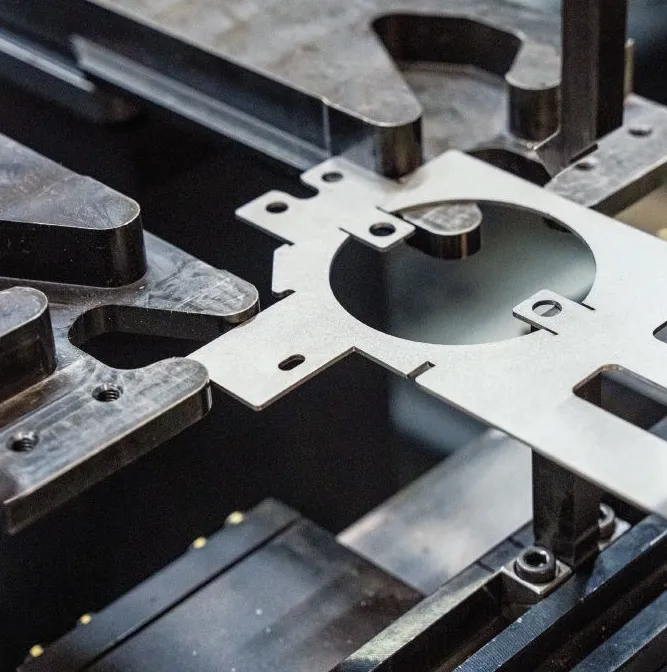
Technology helps simplify routine production tasks so experienced operators can concentrate on complex applications and highervalue work.
COST PER PART
Advanced equipment can change the economics of fabrication, however. Consider two press brakes. One has a significantly lower purchase price. The second requires a larger capital investment but offers faster setup, greater repeatability, easier programming, higher productivity, improved energy efficiency and greater opportunities for automation.
The less expensive machine isn’t necessarily the one with the smaller price tag. The more meaningful calculation is the total cost of producing a good part over the life of the equipment or on an annual timeline. That calculation can include acquisition price, labor requirements, setup time, energy consumption, maintenance, downtime, scrap, rework and overall throughput.
Reducing several minutes from a setup may seem insignificant when viewed as an individual event. Multiply those minutes across multiple changeovers per shift, hundreds of operating days and several years, and setup efficiency becomes a substantial amount of available production capacity.
The same principle applies to reducing operator intervention, preventing incorrect setups, preventing material scrap from forming bad parts, improving first-part accuracy and minimizing rework. Small improvements become much larger when measured across the productive life of a machine.
TECHNOLOGY HANDLES COMPLEXITY
This shift extends well beyond press brakes as equipment becomes increasingly digital, connected and automated. Modern controls can provide a more intuitive user experience. Offline programming can move some work away from the machine. Automated functions can reduce repetitive setup activities, while connected systems provide production information that historically may have been difficult to capture.
Deloitte’s 2025 Smart Manufacturing and Operations Survey of 600 manufacturing executives found that companies implementing smart manufacturing initiatives reported average improvements of 10 percent to 20 percent in production output, 7 percent to 20 percent in employee productivity and 10 percent to 15 percent in unlocked production capacity. Additionally, 92 percent of respondents said they believe smart manufacturing will be a primary driver of competitiveness.
Those figures aren’t specific to bending equipment, but they demonstrate the larger movement occurring throughout manufacturing. Technology is increasingly being asked to do more than make a part. It is being asked to make the entire process easier to manage, measure and repeat.
For bending operations, that can mean controls designed around usability, simplified programming, automated tool changes and setup capabilities, greater process consistency and integration with broader digital production systems.
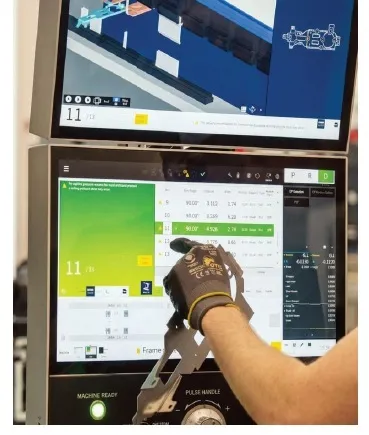
Modern controls can provide a more intuitive user experience.
SQUEEZING THE MIDDLE
As a result, the traditional middle tier of the equipment market is under pressure. For some fabricators, particularly those with lower production requirements or where capital constraints outweigh productivity considerations, entry-level equipment remains a logical choice. The objective is straightforward: Acquire the capability needed at the lowest practical investment.
For another growing group, however, the calculation is moving in the opposite direction. When qualified labor is difficult to find, downtime is expensive, production schedules are compressed and customers expect consistently high-quality parts, spending more on equipment that reduces process variability, increases profit per part by reducing energy consumption and increases productivity in a similar or reduced footprint can become easier to justify.
The premium isn’t simply paying for a better machine. It is potentially buying capacity, consistency, reliability and higher output from the workforce already available.
Automation and advanced machinery are sometimes framed primarily as ways to reduce headcount. In today’s manufacturing environment, the more relevant question may be how technology allows a company to grow when additional skilled employees simply aren’t available.
A DIFFERENT EQUATION
Capital equipment is a major investment, and fabricators will continue to evaluate purchase price. But as manufacturing becomes more digital and skilled labor remains a critical constraint, equipment decisions must account for productivity per employee, setup requirements, ease of operation, energy usage, uptime, consistency and the ability to integrate automation.
When people, productivity and technology are interconnected, the difference between how much a machine costs versus how much it costs to produce a good part could determine which equipment investment delivers the greatest value for years to come.
MC Machinery Systems, mcmachinery.com.