






Above: An operator can select, modify and run slide motion profiles with Allen-Bradley’s servo control system.
October, 2026- Advanced Vehicle Assemblies (AVA) has been manufacturing complex structural metal components and assemblies for the automotive industry since 2021. Today the company, based in Rochester Hills, Michigan, employs nearly 600 people in four manufacturing locations and produces 52.2 million parts annually. In-house forming and joining technology like roll forming, stamping and laser welding help to support its growing customer base.
The need to streamline production of complex components, expand manufacturing flexibility and improve parts-per-minute output prompted AVA to consider adding servoforming stamping presses to its lineup.
Company representatives attended a trade show to learn more about the technology, says Don Lukas, AVA’s chief technology officer and vice president for engineering.
“We looked at AIDA-America’s direct-drive gap-frame servo presses. Then we went to see their factory in Ohio. It was a close race. We were considering another [machinery builder] as well.”
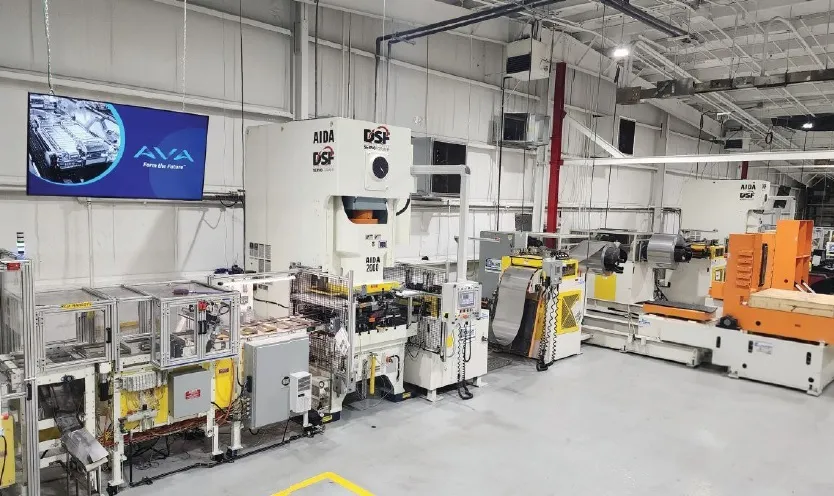
AIDA’s DSF-C1 series gap frame presses paired with Dallas Industries SpaceSaver compact feedlines are helping AVA process high-volume parts from thin material.
QUICK TO MARKET
“We were originally looking at servoforming for EV trays, the structural housings and enclosures used to hold battery packs,” he continues. “One vehicle called for 192 parts with an overall annual volume of 26 million parts per year. We’re shipping 500,000 parts a week, so we needed something quick to market. And they had four AIDA DSF-C1 series gap-frame presses ready to ship.” The model includes Allen-Bradley controls and Dallas Industries SpaceSaver compact feedlines.
AIDA purchased Dallas Industries in 2025 following a partnership that dates back decades. AVA installed two 150-ton AIDA DSF-C1-1500A and two 200-ton AIDA DSF-C1-2000A in July 2025. The manufacturer was in production within 12 weeks.
“Our people were already familiar with Allen Bradley controls and Dallas feedlines, but this was our first experience with servoforming technology,” says Lukas.
AIDA’s attention to detail began with the feedline. Technicians built an edge conditioner four sets of horizontal rolls to scarf material edges to eliminate burrs. “It was tricky,” says Lukas. However, “we’ve now produced millions of parts formed from Grade 304 stainless steel 0.013 inches thick. It’s the thinnest material I’ve ever worked with. We are pushing these presses to the limits, and the system is solid.”
AIDA’s Programmable Limit Switch (PLS) cams proved critical to a multifaceted stamping process. The integrated electronic control systems precisely time automation functions based on the angle, position, upstroke, downstroke or unique slide motion profile programmed by the operator.
MOTION PROFILES
“We were able to control the feed, suction cup part extract, and end-of-line conveyer with the cam outputs of the AIDA press, all while running at 55 spm,” says Lukas.
AVA’s control and programming technicians took to AIDA’s Allen-Bradley controls and its programming interface like a duck to water.
“We have some really smart control guys,” Lukas continues. “They dove in and learned how to program motion profiles. We used the custom profile features [pendulum motion] to half-pitch feed, come down and kiss the part, open the ram, feed full pitch, then final full stroke of partwhich cuts the part from the strip. The AIDA technicians said the press shouldn’t be able to do that.”
AIDA’s ability to provide full tonnage on its servo presses regardless of the job means the press can deliver maximum rated force at any speed, even low speeds. In a traditional mechanical press, the machine’s energy depends entirely on the speed of the flywheel. If
an operator slows the press down to a process like deep draw, the machine can lose flywheel energy and stall. AIDA’s hightorque servo motors eliminate the flywheel and clutch found on conventional equipment and can provide full energy at 1 spm. AIDA overcomes the lack of flywheel inertia by using specialized capacitor banks in conjunction with the servo drive system.
“We’re able to run with a 2-inch stroke and not worry about how much momentum it has,” he says.
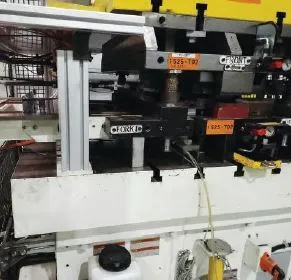
Full rated tonnage and energy is available at 1 spm.
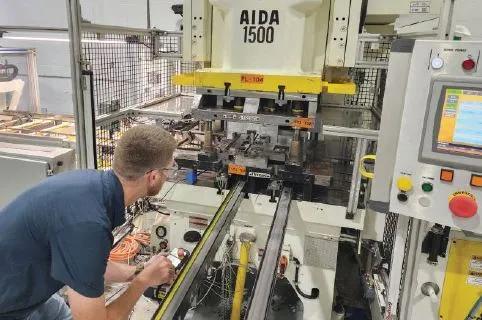
AIDA’s Step Feed Mode allows operators to cycle the press at below 1 spm for die setup and tool try-out.
STEP FEED
AVA uses a hybrid approach in terms of its tooling by managing an established international supply base for major new builds and robust in-house tool and die departments for ongoing operations.
AIDA’s Step Feed Mode, managed through the CNC handwheel control, gives the operator micro-inching capability to perform die setup and trials.
“It’s almost like having a CNC machine,” says Lukas. “With this thin material, we can’t have any burrs. We are trimming a 24-inch-wide strip with 0.0005-inch cutting clearance, so it’s really nice to be able to set a die in the press and have that control.”
Currently, all four servo presses are dedicated to producing upper and lower parts that overlap to form a U shape in the battery enclosure.
“We couldn’t do this job on a mechanical press,” Lukas says. “Without AIDA’s servoforming presses, we couldn’t run these parts at nearly 60 spm and maintain the precise timing of all the ancillary devices.”
Advanced Vehicle Assemblies, 248/329-0306, http://avabuilt.com/
AIDA-America, 937/237-2382, http://aida-global.com/


