






Above: Mike Rowe highlights the critical, hidden work of American shipyards and spotlights the skilled trades that keep global supply chains moving.
September, 2026- The National Association of Home Builders (NAHB) called the skilled labor shortage a “problem hiding in plain sight.” The gap has been as high as 400,000 jobs, it found. In June, NAHB CEO Jim Tobin said that “labor is one of the largest and most expensive inputs when it comes to home production and land development.”
A recent Home Builders Institute and NAHB report estimated builders will need about 723,000 new workers annually to meet demand and help close the 1.5-million-unit housing deficit. As personnel shortages continue to plague landlocked manufacturers, the U.S. shipbuilding industry is also finding its pool of talent drained dry.
At the Surface Navy Association’s national symposium in January 2026, then Secretary of the Navy John Phelan called the skilled labor shortage a critical national security threat. He cited stagnant wages, an aging workforce and a generational shift away from manufacturing.
“Systems don’t build ships,” he said. “People do.” Over the next decade, shipbuilders and suppliers will need to hire roughly 250,000 skilled workers to build and maintain the U.S. Navy’s Golden Fleet.”
More than 75 percent of employers from frontline-heavy industries healthcare, IT, consumer goods, automotive, industrial and communication, to name a few report persistent labor shortages that are hindering growth, delaying projects and costing a number of companies one workday a week.
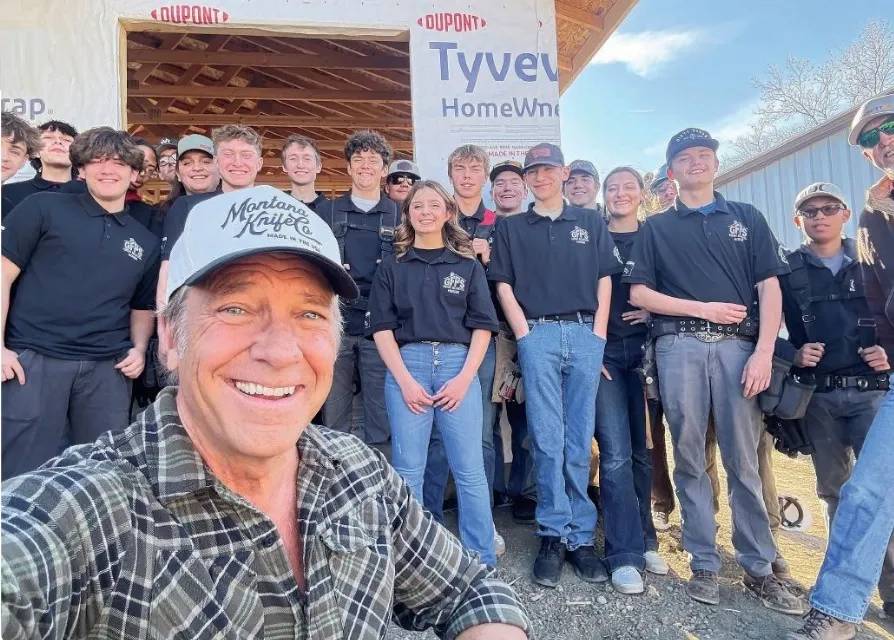
A high school shop class in Great Falls, Montana, is building houses to code from the ground up that are move-in ready.
THE CASE
For more than two decades, Mike Rowe has been warning the nation about the downstream consequences of “falling out of love with the skilled trades.” The creator and host of the hit Discovery Channel series Dirty Jobs, an author, a commercial spokesman and the founder and CEO of the mikeroweWORKS Foundation predicted the widening skills gap and identified structural and cultural problem areas years before they became the nationwide crisis that job shops, contract manufacturers and fabricators face today.
“When I talked with FFJournal in March 2017, I had serious concerns about recommending one form of education at the expense of others,” he says. “We’ve always had this tendency to draw clear lines in the workforce between white collar and blue-collar jobs. We’ve put our thumb on the scale with regard to pushing the advantages of a college degree over a trade school or apprenticeship program. Today, we’re seeing the consequences of that. I talk to a lot of people quite often about this issue and they all say, ‘yeah, the scales have tipped, now what are we going to do about it?’”
Economic experts identify 2017 as the peak year for what many call “blue-collar automation anxiety.” Concerns about robots taking human jobs hit such a high that individuals like Microsoft’s Bill Gates floated the idea of a robot tax to level the playing field. In 2026, technology like generative AI has eclipsed those fears.
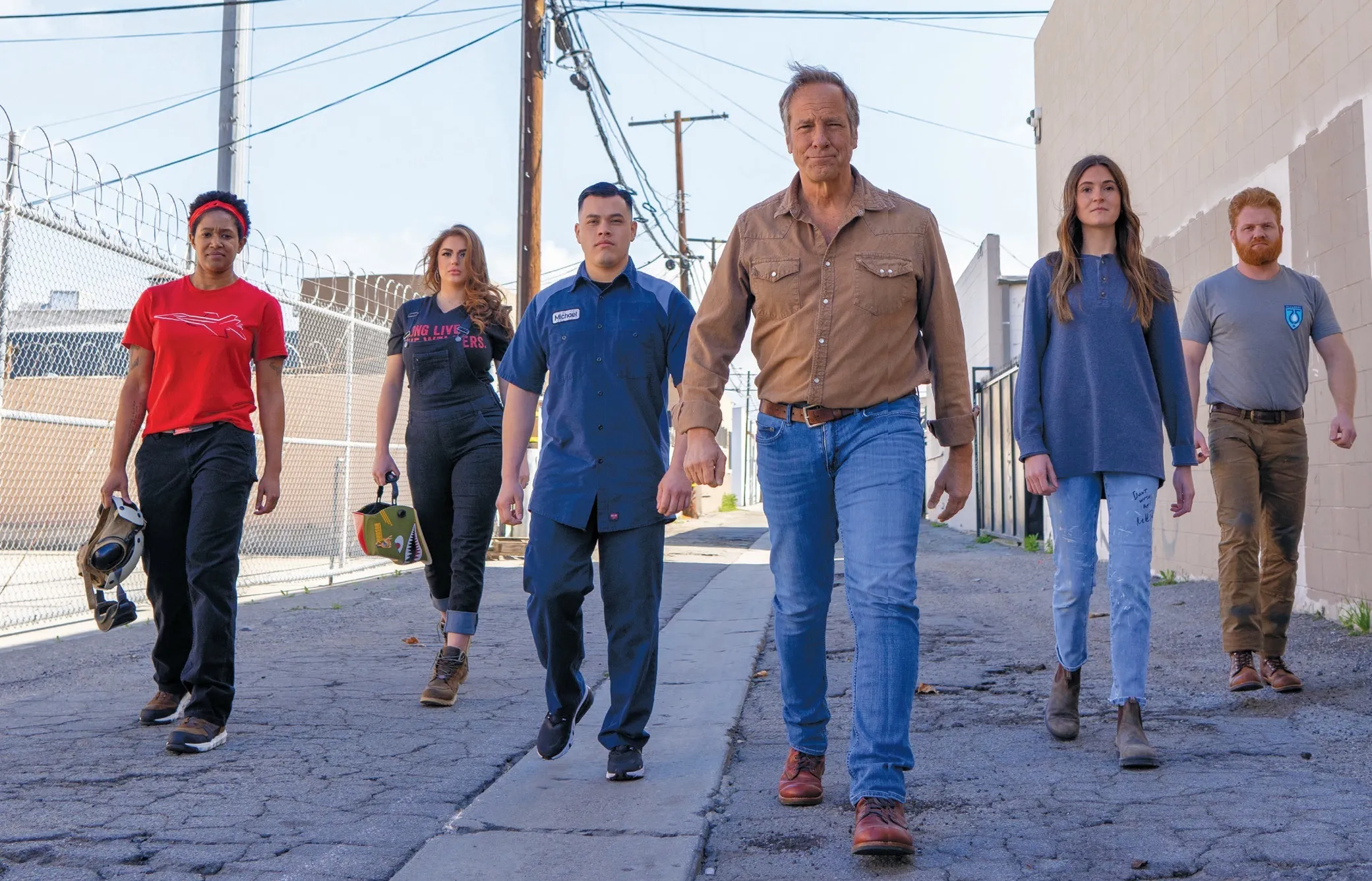
Mike Rowe and his foundation, mikeroweWORKS, is leading the charge to help build the next generation of skilled trades professionals.
“It’s driving an entirely new conversation,” says Rowe. “It’s fueling a $10 trillion infrastructure that is going to be built whether we like it or not. Ten years ago, it was popular to point to robots and automation and say, ‘they are coming for the blue-collar worker.’ Turns out they are not. Not a week goes by that I don’t get a phone call from a leader of an influential industry or company who wants to talk about ways to reinvigorate the skilled trades in their respective field.”
It’s an answer that Rowe has been working on since Labor Day 2008, when he launched the mikeroweWORKS Foundation. The 501(c)(3) charity was created to revive and refocus attention on the skilled trades. It has since grown a well-funded scholarship program that awards millions of dollars to students pursuing trade-related programs.
The foundation’s Work Ethic Scholarship Program does not focus on traditional grades but evaluates applicants on their work ethic, personal responsibility and attitude. The S.W.E.A.T. Pledge, an acronym for “Skills and Work Ethic Aren’t Taboo,” is a manifesto created by Rowe that outlines beliefs about personal responsibility and delayed gratification. Applicants for scholarships are required to sign and agree to it. The foundation works to reshape public perception by advocating that a four-year university degree is not the only path to a successful and lucrative career.
This year, mikeroweWORKS is partnering with the Department of Defense for the launch of its Build Freedom initiative. In July 2026, DoD awarded $10 million to mikeroweWORKS to fund scholarships to train veterans, students and young adults in areas that are critical to the Defense Industrial Base (DIB). The foundation has also forged relationships with a number of other companies, including Wells Fargo, Meta, BlackRock Inc. and Ford Motor Co.
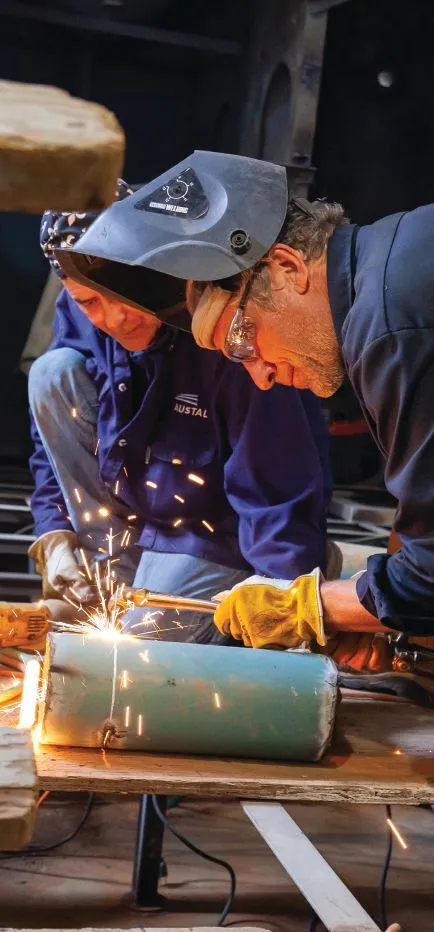
Welding and pipefitting are key skills for construction of a tugboat.
DISCOVERY
“Partnering to solve the skills gap has expanded beyond manufacturing to include organizations that range from finance and healthcare to Silicon Valley,” Rowe says. “Shifting demographics and rapid technological disruptions like AI and automation have brought overlapping talent shortages to their doorsteps and that of their clients. They have begun to realize that no matter how carefully one plans whether its data centers or other infrastructure a robust pipeline of skilled labor is going to be critical to what we need to do in the future. The pinch here isn’t money, it’s labor.”
A decade ago, hands-on professions such as plumbers, electricians, HVAC technicians and mechanics were a localized economic concern. According to Rowe, that shortage has now become a macro-level national security bottleneck. The U.S. Navy needs to hire more than 100,000 skilled workers over the next 10 years to build and maintain nuclear-powered submarines and advanced naval fleets.
In addition to engineers, the Defense Industrial Base is hungry for welders, machinists, steamfitters and pipefitters to meet military specifications that allow zero room for error.
Polymetallic nodule deep-sea mining is an emerging industry that will also require a thriving talent pool. These potato-sized mineral-dense concretions, made from cobalt, nickel, copper and manganese, have the potential to supply the metals needed for electric vehicle batteries, wind turbines and other green technologies. Specialized surface ships, heavy-duty vertical piping systems and subsea collector/harvesters fitted with hydraulic suction heads or AI-guided robotic arms are key pieces of equipment needed to process the nodules.
Rowe is a founding investor and special advisor to the American Ocean Minerals Corp. (AOMC) which merged with Odyssey Marine Exploration to establish a $1 billion deep-sea critical minerals platform.
“This industry is going to open up about 100,000 jobs that currently don’t exist,” Rowe predicts. “Filling those positions is going to be extraordinarily important. You’ve got data centers, shipbuilding, mining, transportation and the traditional trades, all being fueled by a resurgence in manufacturing that’s just going to throw gasoline on the fire.
“When you look at what is going to happen with these industries, the metals story is going to become as large as the energy story,” he continues. “We need to be metals independent in the same way that we are energy independent. And that goes back to investing in the workforce and rethinking the path that we push young people down.”
THE EVIDENCE
The massive labor deficit spans construction and manufacturing but, according to Rowe, “it’s difficult to solve the problem until one understands the big picture.”
For every five skilled tradespeople who retire or leave the workforce, only two new workers enter the field to replace them, according to industry statistics. With a projected vacancy rate of 25 percent for trade jobs, America faces significant shortages across specific fields. Construction Industry Employment Data estimates 400,000 to 500,000 open roles for electricians, HVAC technicians and welders. The imbalance has reached a melting point as baby boomers retire with too few young adults entering trades apprenticeship programs.
“The demographic challenges are real and it’s been that way for 12 years,” says Rowe, “So there’s a huge math problem underneath all of this and there is not much we can do about that. The stigmas, stereotypes and misperceptions that have kept people from exploring the trades are also real and they need to be debunked. Because the gap is not a universal problem, education has to take place in different ways. In some areas, it’s a true mismatch of skills but, in other places, it’s still a profound misunderstanding and a disbelief that a person can made six figures a year as a third-year electrician or pipe welder.”
It’s the reason the mikeroweWORKS Foundation has moved outside traditional manufacturing to “AI-proof” careers across infrastructure, construction and national security by partnering with major technology, finance and defense organizations. The foundation secured multi-million-dollar investments and workforce advocacy campaigns from Wells Fargo to support trade school enrollment. Buildfreedom.us, a $10 million workforce initiative backed by the Defense department, will train workers for the Defense Industrial Base. The foundation also teamed with Meta on America’s Workforce Academy, a $115 million national training program for construction and skilled trade careers.
In addition to these initiatives, Rowe has criss-crossed the country this year touring factories and steelmakers and meeting with politicians. More importantly, he has been searching out, meeting with and telling the stories of people who are building their own pathways to financially secure careers in the trades.
“The evidence demands a verdict,” he says. “We have to present the evidence and prosecute the case. We do that by telling people’s stories because that is what moves the needle more than anything else.”
Manufacturers also have a role to play in creating the next generation of skilled workers by how they market to young people and by the example they set.
“I’ve been in advertising my whole life,” says Rowe. “The question is, ‘What is persuasive?’
Right now, we’re in a time where the answer changes every couple of years. It’s no longer a traditional approach. Kids know when they are being marketed to. They know when they are being recruited.
“In my opinion what companies need to remember is that there are really only two kinds of messages that win people over. It’s either a really satisfied customer who loves your company and your products, or an excellent employee who is prospering because they mastered a skill and applied a good work ethic to the task. The country needs to hear from people who have climbed the ladder and risen through the ranks.”
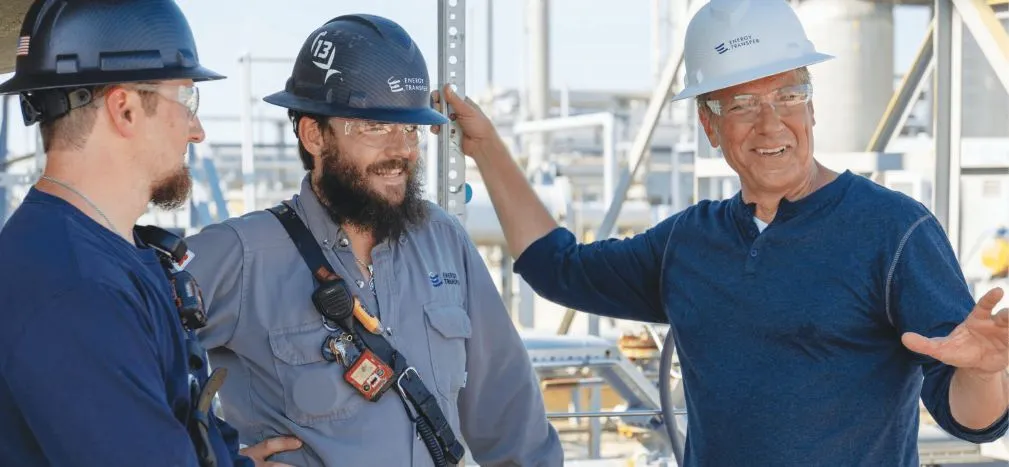
From mechanics and plant managers to pipefitters, Mike Rowe spends the day with Energy Transfer employees to spotlight skilled trade professionals.
THE VERDICT
Rowe urges manufacturers to become evangelists for the trades to secure their futures. A shift from passive hiring to active promotion is a solid step toward eliminating outdated stigmas and generating excitement among young people about the career opportunities that the trades offer.
The mikeroweWORKS Foundation has set aside $10 million this year for its Work Ethic Scholarship program. To date, the organization has helped 3,500 people and expects to double that number in 2026. It has received 10 times the applicants over those processed in 2025.
“We’ve awarded electricians, linemen, carpenters, welders, steamfitters, pipefitters, plumbers, machinists, HVAC technicians, auto technicians, aviation technicians, and many more who prove that you don’t need a four-year degree to start an AI-proof, six-figure job,” Rowe says.
“This shows me the word has gotten out and that slowly, parents, guidance counselors and kids are starting to realize that maybe the best path for a lot of people isn’t the most expensive route. There are many ways to make a buck in the trades and there is dignity in that work.”
In the face of massive infrastructure investments, disruptive technologies and renewable energy, contract manufacturers, fabricators and large corporations are being forced to recognize that the trades offer high leverage, competitive pay and strong job security. Demand for trade roles is growing exponentially, outpacing white-collar job growth by nearly three to one, according to Randstad USA, the American division of Randstad N.V., the world’s largest human resources and staffing firm.
“Skilled labor is having a moment,” says Rowe. “The country is realizing the value of handson talent in a way I haven’t seen since my grandad’s generation was out there building homes, shaping communities and creating new products with craftsmanship and applied mathematics. I think we are on the cusp of a renaissance of sorts.”
mikeroweWORKS Foundation, mikeroweworks.org
SCHOLARSHIP
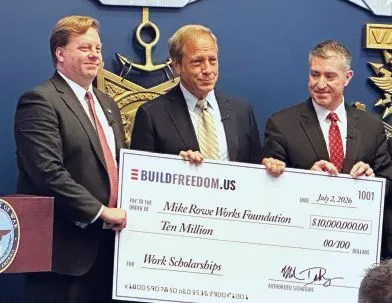
Against the backdrop of America’s 250th birthday celebration, the U.S. Office of the Assistant Secretary for the Industrial Base Policy established Build Freedom on July 1. The initiative promotes skilled trades in the U.S. and initially launched in Texas, Michigan and Pennsylvania with more states to be added later this year. Build Freedom joined with Mike Rowe and his foundation mikeroweWORKS to foster a talent pipeline and strengthen America’s defense manufacturing and industrial base.
Both the U.S. government and the Defense department recognized the urgent need to train the next generation of skilled trade professionals. Through the buildfreedom.us website, candidates can access specialized trade scholarships, local apprenticeship tracks, training programs and live employment postings.
“The gap is widening and it’s affecting our country’s ability to build ships, aircraft, vehicles, defense systems and energy infrastructure,” says Rowe. “It’s also making it hard for the average American to find a plumber or an electrician. Build Freedom is a national effort to reinvigorate the skilled trades by shining a light on hundreds of thousands of AI-proof sixfigure jobs currently open in the Defense Industrial Base. My foundation is pleased to off er scholarships for these essential jobs and I’m honored to help launch the initiative.”
The Office of Defense Industrial Base Policy announced a $10 million grant to mikeroweWORKS and its Work Ethic Scholarship Program.